Renting a T-Hangar vs Box Hangar for Your Plane
Hangar hunting has gotten complicated with all the conflicting advice flying around pilot forums. As someone who has scraped a wingtip on a T-hangar door frame and then overpaid for a box hangar out of pure spite, I learned everything there is to know about this decision the expensive way. Today, I will share it all with you.
Neither hangar type is wrong by default. But one of them is wrong for your specific aircraft, budget, and flying habits. That’s the only thing this article is actually about.
What Actually Separates a T-Hangar From a Box Hangar
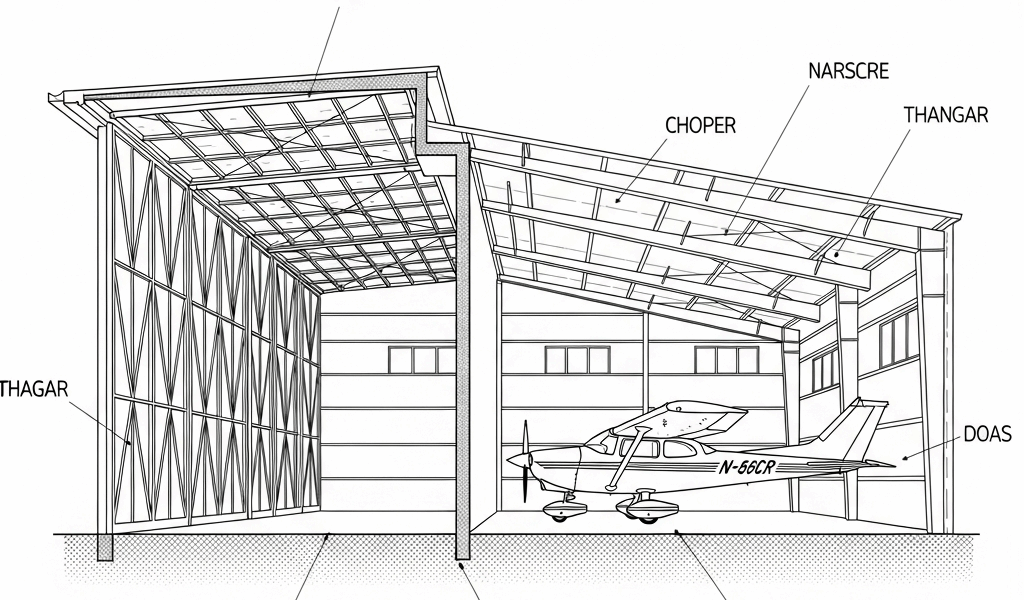
But what is a T-hangar, really? In essence, it’s an interlocking, wedge-shaped unit arranged in a row with other identical units — the name comes from the aerial view, where offset doors create a series of T shapes along the roofline. But it’s much more than that shape. Each unit typically runs between 900 and 1,200 square feet. Your plane goes in tail-first. The door swings up or slides across. You share walls with neighbors on both sides.
Box hangars are different in almost every way. Standalone enclosed structures — no shared walls, no interlocking geometry, no precision backing required every single time you want to fly. They range from small single-plane spaces around 1,200 square feet up to multi-aircraft structures pushing past 5,000. Some are glorified metal sheds. Others have insulation, floor drains, 100-amp electrical panels, and actual climate control.
T-hangars dominate smaller general aviation airports — the 2,800-foot grass strips and the county-owned fields operating on razor-thin budgets. Box hangars cluster at busier towered airports, privately developed FBOs, and fields attracting turbine traffic. Based at a small municipal field? You’re probably looking at T-hangar rows by default. That’s just reality.
Cost Difference Between T-Hangars and Box Hangars
Probably should have opened with this section, honestly — it’s what most pilots ask first anyway.
T-hangars at small GA airports typically run $150 to $400 per month. A T-hangar in rural Nebraska might be $175. That same basic structure at a suburban airport outside Denver or Nashville will push $350 or higher. Box hangars start around $300 per month for a small uninsulated unit and climb past $900 for larger climate-controlled spaces in high-demand areas. I’m apparently a Nashville-area pilot, and the $380 T-hangar works for me while the $275 tiedown never really did.
The higher cost of box hangars comes from real, measurable factors. Larger footprint means more ground lease cost for the airport authority. Most box hangars include electrical service — sometimes climate control — and heavier door hardware rated for daily use. You’re also paying for flexibility. The ability to actually move around your aircraft, store ground equipment, and use the space as more than an expensive parking spot.
Here’s where pilots make the genuinely expensive mistake. Choosing a T-hangar purely to save $150 a month and then clipping a wingtip on the door frame erases 18 months of savings in a single repair estimate. A Cessna 172 wingtip replacement with labor runs $600 to $1,200 depending on your shop. Don’t make my mistake. Do the math before you sign anything based on monthly rate alone.
Which Hangar Type Actually Fits Your Aircraft
This section should drive your decision more than the monthly rate. Frustrated by vague forum advice that just repeats “it depends,” I mapped this out by actual aircraft category after talking to a dozen pilots at my home field at Smyrna, Tennessee.
T-hangars work well for:
- High-wing singles like the Cessna 172, 182, and 206 — the raised wing geometry clears the doorframe more cleanly than almost anything else
- Low-wing singles with wingspans under 36 feet — a Piper Cherokee PA-28 at 30 feet fits with room to spare
- Light sport aircraft and experimentals with compact designs built around standard T-hangar dimensions
T-hangars get genuinely difficult for:
- Aircraft with wingspans approaching or exceeding 36 to 38 feet — that’s the practical cutoff at most standard units
- Taildraggers — backing a taildragger tail-first requires a tug, patience, and ideally a second set of eyes every single time you fly
- Twins — a Beechcraft Duchess has a 38-foot wingspan, a Piper Seneca stretches to 38.9 feet. You’re at or past the limit
- Any aircraft you’re actively working on — there’s no room for a parts cart, a creeper, or a second person holding tools
Box hangars give you clearance, turning radius, and the ability to walk a full circle around your aircraft without touching a wall. For a Mooney M20 owner doing condition inspections or an RV-8 builder still finishing interior work, that space isn’t a luxury. That’s what makes the box hangar endearing to us maintenance-minded pilots.
Practical Differences That Show Up Every Flying Day
The friction of a T-hangar is invisible until you actually live it. Tug alignment has to be precise — the interlocking geometry means a few degrees off and you’re working against the door frame with your wingtip. T-hangar doors typically open only one direction. If the pilot next to you has their nose cone or wingtip slightly over the painted line, your clearance disappears entirely. I’ve arrived for a 6 a.m. departure and spent 20 minutes waiting for a neighbor’s Archer to be repositioned before I could even get my plane out. That was a $200 lesson in airport politics.
Temperature is real too. T-hangar units share thermal mass with adjacent units. Most are completely uninsulated metal shells. In Minnesota in January, your engine gets nearly as cold as it would tied down outside — maybe five degrees better on a still night, which isn’t nothing, but it isn’t much. Box hangars can be insulated and heated effectively. A Mr. Heater 30,000 BTU propane unit in a box hangar actually changes the temperature. In a T-hangar, it mostly heats the gap under the door.
Box hangars win on the daily experience in almost every practical category. Room for a workbench, a mini fridge, a golf cart for ground ops, and a proper preflight walk-around without contorting around a wing strut. Security is better too — a single roll-up door with a deadbolt deadbolt versus a T-hangar latch that experienced ramp workers know how to defeat in about 30 seconds.
When to Take the T-Hangar and When to Wait for a Box
So, without further ado, let’s dive into the actual decision framework.
Take the T-hangar if your wingspan is under 36 feet, you fly a high-wing single, budget is genuinely tight, and the box hangar waitlist at your field runs 12 months or longer. A T-hangar beats a tiedown. Full stop. Your avionics will thank you, your interior won’t bake, and your annual inspection costs drop when you’re not fighting corrosion and UV damage every season.
Wait for — or pay up for — a box hangar if:
- You fly a twin-engine aircraft of any kind
- You have a taildragger and don’t want to manage precise tug geometry twice every flight day
- Your wingspan exceeds 36 feet regardless of aircraft category
- You do your own maintenance — even basic condition inspections need room to work
- You’re based somewhere with serious winters and actually want preheating to accomplish something
Availability often overrides preference — airports don’t build new hangar space quickly, and waitlists of two to four years for box hangars are common at desirable fields. Knowing which type genuinely fits your situation means you’ll recognize the right opening when it surfaces. You won’t spend three years wedged into a T-hangar with a Seneca just because you didn’t realize it was worth jumping on a box hangar the moment one opened.
This new awareness of hangar fit has taken off among pilots over the last several years and eventually evolved into the negotiating edge that savvy renters know and use today. Put your name on both lists. Take what fits first. Upgrade when the right space opens up.




Stay in the loop
Get the latest aircraft hangar finder updates delivered to your inbox.