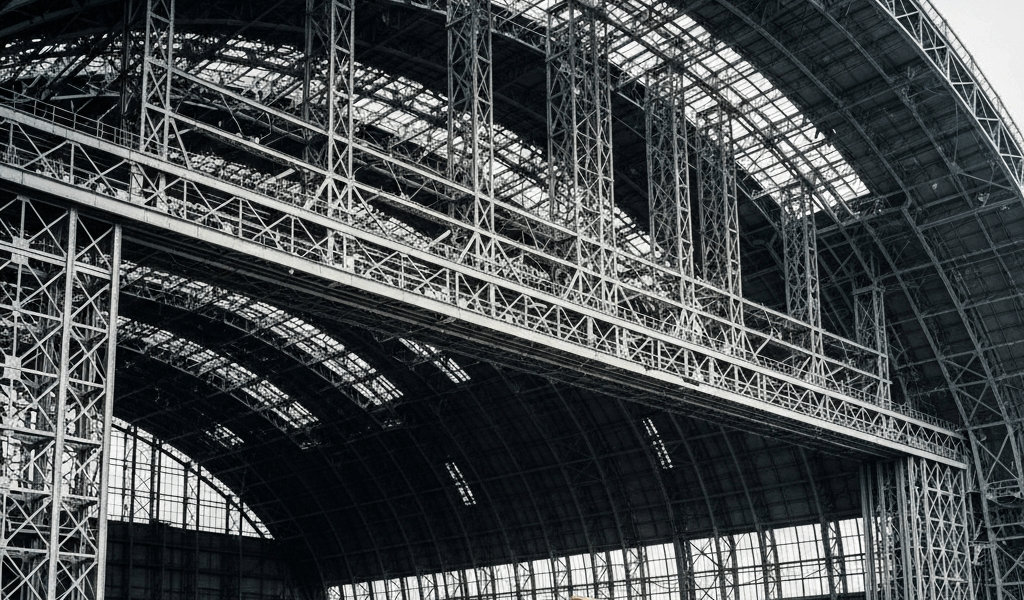
Someone at the airport casually asked why we call it a hangar and not a garage or a shed. It is a reasonable question — the word does not sound like any other building name in English. The answer goes back to a small town in France and a lighter-than-air ship that needed a very large roof.
The French Origin: A Big Building in a Small Town
The word “hangar” comes from French, borrowed into English in the 1850s. It originally meant a covered shelter or shed, likely derived from the Frankish word “haimgard” — a compound meaning “home enclosure.” The French used “hangar” for large agricultural sheds and storage buildings before aviation existed.
The connection to aviation came through dirigibles and balloons in late 19th century France. The structures built to house these enormous gas-filled aircraft were the largest enclosed spaces of their era — far bigger than anything agriculture or industry required. The French term for the buildings that housed them carried directly into aviation vocabulary.
Why the Word Stuck in English
Early aviation was dominated by French terminology because France led early powered flight development alongside the Wright Brothers. Fuselage (from “fusele” — spindle-shaped), aileron (little wing), empennage (tail assembly) — all French words that became standard English aviation terms. “Hangar” arrived the same way: English-speaking aviators adopted it because the French were already using it for the buildings that housed aircraft.
The word entered English with a specific aviation meaning that the French original did not have. In France, a “hangar” could be any large covered structure. In English, it means specifically an aircraft storage building. We narrowed the definition when we borrowed the word — a common pattern in English vocabulary where borrowed terms become more specialized than they were in the source language.
The Dirigible Era: When Hangars Got Enormous
The word “hangar” became permanently associated with aviation during the dirigible age, roughly 1900 to 1937. Airships like the Zeppelins required buildings of extraordinary size — the hangar at Lakehurst, New Jersey (where the Hindenburg burned in 1937) enclosed over 8 acres of floor space and stood 200 feet tall. These were the largest free-span structures on Earth when they were built, and calling them a “shed” or “garage” would have been absurd.
After the Hindenburg disaster effectively ended the airship era, the buildings remained and the word remained with them. As heavier-than-air aviation grew, every building that housed aircraft — from the massive bomber hangars of World War 2 to the small T-hangars at your local general aviation airport — inherited the term. A T-hangar holding a Cessna 150 has nothing in common physically with a dirigible shed, but it carries the same name because aviation vocabulary fossilized around the original term.
Hangar vs Hanger: The Spelling Trap
A hangar stores aircraft. A hanger holds your coat. The spelling difference is one letter and the number of people who get it wrong — including aviation professionals — is surprisingly high. The words have completely different origins. “Hanger” comes from the Old English “hangian” — to hang. “Hangar” comes from the French shelter word described above. They sound identical in spoken English, which is why the confusion persists.
If you work in aviation and spell it “hanger” in an email, someone will notice. And they will remember.




Stay in the loop
Get the latest aircraft hangar finder updates delivered to your inbox.