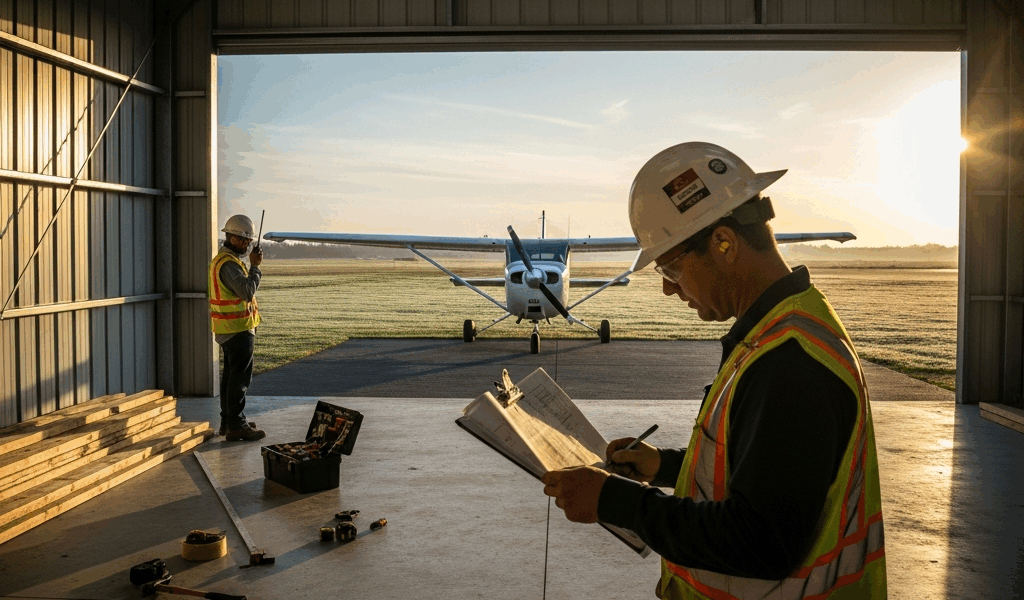
How Much Does It Cost to Build a Small Aircraft Hangar in 2026?
The small aircraft hangar cost to build in 2026 lands somewhere between $150,000 and well over $500,000 depending on size, construction method, and how many surprises your site throws at you. I spent two years researching this before breaking ground on a 60×60 pre-engineered steel hangar in rural Tennessee, and the number I originally budgeted was embarrassingly wrong. Not wrong by 10 percent. Wrong by nearly $80,000. The hidden costs are where pilots get hurt, and most of the manufacturer websites you’ll find through a Google search are designed to get you excited about a building kit price — not prepare you for what the whole project actually costs.
This article is the breakdown I wish I’d found before I started making phone calls. Real 2026 numbers, organized by construction type and size, with the stuff that gets left out of the glossy brochures included in full.
2026 Cost Per Square Foot by Construction Type
There are three realistic construction paths for a private aircraft hangar. Pre-engineered steel, conventional steel, and concrete block or tilt-up. Each has a legitimate use case, and each comes with a very different price tag per square foot of enclosed space.
| Construction Type | Cost Per Sq Ft (2026) | Best For |
|---|---|---|
| Pre-Engineered Steel | $25 – $35 (kit only) | Private owners, budget builds, rural sites |
| Conventional Steel | $60 – $120 | Larger operations, FBO facilities, customization |
| Concrete Block / Tilt-Up | $80 – $150 | High-wind zones, long-term investment properties |
A few things to clarify here. The $25–$35 figure for pre-engineered steel is the building kit price — the steel panels, framing, and hardware shipped to your site. It does not include foundation, erection labor, doors, electrical, or any site work. The total installed cost for a pre-engineered steel hangar typically runs $65–$95 per square foot when you add everything up. That’s still meaningfully cheaper than conventional steel or concrete, but the gap closes faster than the kit price alone suggests.
Conventional steel-framed construction gives you more flexibility in design — taller eave heights, longer clear spans, easier integration of office or shop space. Architects and structural engineers I spoke with in 2025 consistently quoted $75–$120 per square foot for hangar-specific conventional steel builds, with coastal and high-seismic-zone projects pushing toward $130–$150. Concrete is durable and thermally efficient, but labor costs in 2026 make it the most expensive path for most private owners unless they have a specific structural or insurance reason to go that direction.
Total Build Cost by Hangar Size
Probably should have opened with this section, honestly. Most people searching for hangar costs want to know what they’re going to write on a check, not abstract per-square-foot math. So here’s what real projects cost at the three most common footprint sizes for private aviation.
40×40 — Single Engine, One Plane
A 1,600 square foot hangar fits most single-engine piston aircraft with room to move around and a small workbench along the back wall. A Cessna 172 has a 36-foot wingspan, so a 40×40 works, but it’s snug. A Piper Cherokee fits more comfortably. Total build cost in 2026 for a pre-engineered steel 40×40 with a concrete slab, basic electrical, and a hydraulic bifold door runs $150,000 to $250,000. The wide range comes down primarily to door choice and regional labor rates. If you’re in the upper Midwest, you might hit $155,000. If you’re building in California or the Northeast, expect to push past $220,000 easily.
60×60 — Two Planes or One Multi-Engine
This is the sweet spot for most serious private owners. A 3,600 square foot footprint handles a twin-engine piston comfortably, or two singles with space for a golf cart and a shop area. Inspired by what I saw at a neighboring airport in Kentucky where a Beechcraft Baron owner built exactly this configuration, my own 60×60 came in at $312,000 all-in — including a 50-foot hydraulic bifold door from Schweiss Doors, a 4-inch reinforced slab, LED shop lighting, a 200-amp service panel, and gravel site work. Expect $280,000 to $400,000 for a 60×60 in 2026 depending on your finishes and location.
100×100 — Serious Storage or Small Charter Operation
At 10,000 square feet, you’re in a different financial universe. A 100×100 clear-span pre-engineered steel structure runs $500,000 and up, often significantly up. A project manager I spoke with at a regional airport in Georgia quoted $680,000 for a 100×100 conventional steel hangar with two T-hangars partitioned inside, full HVAC, a pilot lounge, and a concrete apron. If you’re considering a structure this size, the financing, FAA lease requirements on airport property, and local zoning complexity start to matter as much as the construction cost itself.
Hidden Costs Most Estimates Miss
This is where my budget fell apart. The building kit quote from Nucor Building Systems was legitimate. The total project cost was not what I expected, because I hadn’t accounted for six separate line items that don’t appear in any manufacturer’s brochure.
Site Preparation
Clearing trees, grading, and bringing a site to a level, stable building pad can cost $5,000 on an easy rural lot or $40,000 on a site with drainage issues or significant topographic change. My site required importing 180 tons of compacted gravel fill. That was $14,000 I hadn’t budgeted. Get a geotechnical assessment before you finalize any numbers — around $1,500 to $3,000 for a basic soil report, but worth every dollar.
Foundation and Concrete Slab
A 4-inch slab on grade for a 60×60 hangar runs $18,000 to $28,000 in most markets. If you want a 6-inch slab for heavier aircraft or to handle forklift loads, add 20 to 30 percent. Perimeter footings for the steel frame add additional cost. Budget $22,000 to $35,000 for foundation work on a mid-size hangar.
Concrete Apron
The apron — the paved area outside your hangar door where you push the plane in and out — is almost always excluded from building quotes. A 60×40-foot apron at 6 inches thick runs $12,000 to $20,000. Skip it and you’ll be pushing your airplane through gravel. Nobody does that twice.
The Door
Bifold hydraulic doors are expensive. Full stop. A 50-foot-wide hydraulic bifold from Schweiss Doors or Hydroswing runs $18,000 to $35,000 for the door unit alone, not counting installation, which adds another $3,000 to $6,000. Sliding doors are cheaper — closer to $8,000 to $14,000 for a comparable opening — but they require clearance on both sides and ice and debris tend to foul the track in northern climates. The door is often the single most expensive line item after the slab.
Electrical Service
A 200-amp panel with a utility company connection, interior LED lighting, two 240V outlets for equipment, and exterior security lighting costs $8,000 to $18,000 depending on how far you are from the nearest transformer. If you’re building on airport property, the airport authority may charge a tap fee on top of that. I paid $2,800 in tap fees at my home county airport that nobody mentioned until week three of the project.
Permits and Engineering Stamps
Permit fees vary wildly by jurisdiction — as low as $500 in rural counties and as high as $8,000 in municipalities with percentage-of-project-value fee structures. Pre-engineered steel kits come with stamped drawings from the manufacturer’s engineer, but many jurisdictions require a local PE to review and re-stamp. Budget $1,500 to $4,000 for engineering and $1,000 to $5,000 for permits, and call your county building department before assuming anything.
Build vs Rent — The 10-Year Math
Renting a T-hangar at a public airport currently runs $250 to $600 per month in most mid-size U.S. markets, with larger box hangars and corporate facilities running $800 to $2,500 per month. Waiting lists for T-hangars at popular airports are long — two to five years is not unusual in the Southeast and Southwest. That scarcity alone drives many owners toward building.
Here’s a straightforward break-even comparison. Assume you can rent a T-hangar for $400 per month, which is $4,800 per year. Over 10 years, that’s $48,000 in rent, and you own nothing at the end. Now assume you build a 40×40 pre-engineered steel hangar for $190,000. At a 7 percent borrowing cost over 15 years, your monthly payment is roughly $1,708. That’s more than four times the rent payment.
So when does building win? It wins when you factor in property value. A hangar on land you own adds tangible real estate value. A well-built hangar on a private airstrip or on leased airport ground with a long-term lease can be sold or transferred. Rent payments are gone forever. A $190,000 hangar may carry a $160,000 asset value after 10 years on the right property.
Building also wins when rent isn’t available. If you’re on a two-year waiting list paying $250 per month somewhere that doesn’t meet your needs, the calculus changes. It wins when you need more space than rental inventory offers. And it wins when you’re building on private property you already own, eliminating land cost from the equation entirely.
The math rarely makes building look cheaper on a pure monthly cost comparison. It makes building look rational as an asset and lifestyle decision — which is how most owners who do it frame the choice.
Pre-Engineered Steel — The Budget Option That Works
Pulled toward the idea of building by a three-year hangar waiting list at my home airport, I ended up going deep on pre-engineered steel options before committing. The short version: it’s not a compromise. It’s the right answer for most private owners building a hangar in 2026.
Pre-engineered steel buildings use factory-manufactured primary framing, secondary framing, and metal skin panels that bolt together on site. The structural calculations are done at the factory for your specific load requirements — roof snow load, wind speed, seismic zone. What arrives on a flatbed is essentially a purpose-built kit designed for your site conditions. A trained crew erects the frame in two to four days for a 60×60 building. The whole shell can be weather-tight in under two weeks.
Lead Times in 2026
Lead times tightened significantly after 2021 and have partially recovered. As of early 2026, most manufacturers are quoting 12 to 18 weeks from order to delivery. MBCI, Nucor Building Systems, and Robertson-Ceco are the three largest domestic manufacturers. American Buildings Company and Metallic Building Company are strong regional options with slightly faster lead times in some markets. Do not order a kit without a confirmed contractor lined up for erection — kit delivery and contractor availability need to be coordinated, and good erection crews book out 8 to 12 weeks in advance.
What to Watch For
The biggest mistake people make with pre-engineered kits is under-specifying. The default trim package, insulation liner, and ventilation specs from a basic quote are often inadequate for a working hangar. Upgrade to a two-inch insulated liner system if you plan to heat the space — the base blanket insulation is code-compliant but not functional for a climate-controlled environment. Specify ridge ventilation and at least two gable-end louvers to manage condensation. And confirm your eave height before you sign — 14-foot eave height is standard, but if you have a high-wing aircraft with a tall tail, you may need 16 or 18 feet, which adds cost.
Building a hangar is a significant project with real financial weight. But for a plane owner who expects to stay in one place, wants control over their storage and maintenance environment, and has access to suitable land, 2026 is a reasonable time to do it. Steel prices have stabilized compared to 2022 highs. Labor markets have loosened slightly. And the cost of doing nothing — sitting on a waitlist paying rent for space that doesn’t fit your airplane — has its own price that doesn’t show up on any quote sheet.



Stay in the loop
Get the latest aircraft hangar finder updates delivered to your inbox.