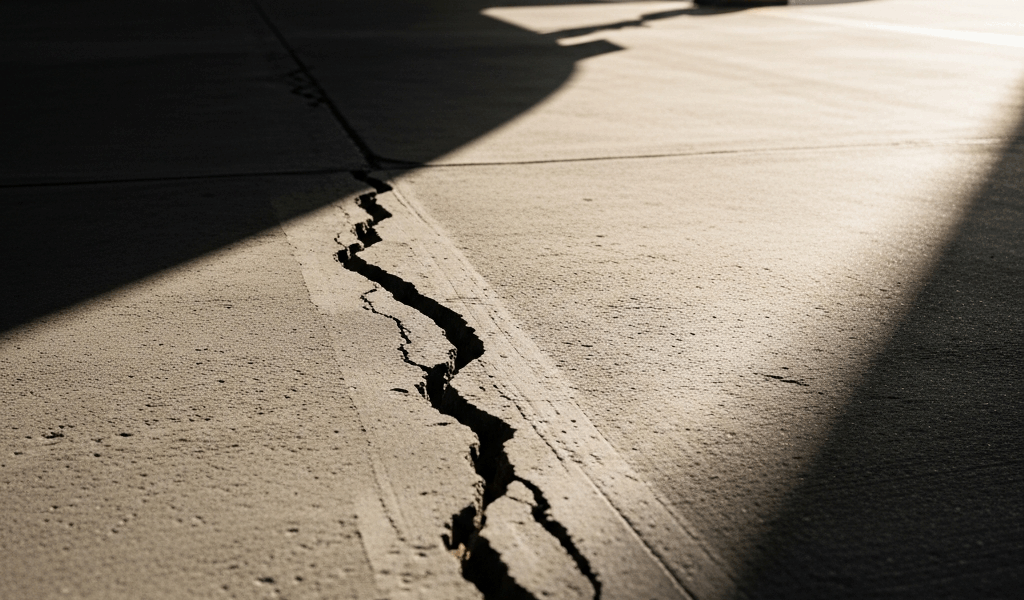
Why Hangar Floors Crack in the First Place
Hangar floor maintenance has gotten complicated with all the conflicting advice flying around. As someone who’s spent six years renting space at three different Midwest airports, I learned everything there is to know about concrete deterioration the hard way. Today, I will share it all with you.
The first time I spotted a crack snaking across my ramp during preflight, I genuinely panicked. Was the building sinking? Was I liable? Should I be calling a lawyer at 7am? Turns out — no. Hangar floors crack for entirely predictable reasons, and most of them have nothing to do with anything you did.
Concrete shrinks when it cures. That’s just chemistry. A fresh pour loses moisture over weeks and months, contracting as it dries. Contractors are supposed to score control joints to manage those forces — but if the mix ran too wet, or the joints were spaced wrong, shrinkage stress concentrates wherever it wants and cracks follow. Not a failure. Just physics doing its thing.
Ground settling is a nastier problem. Soil that wasn’t properly compacted before the pour, or drainage patterns that shifted over twenty years — either one lets the foundation move unevenly. One corner drops a quarter-inch while the rest stays put. That differential stress cracks concrete reliably every time.
Heavy aircraft parked in the same spot compound everything. A Cirrus SR22 sits at roughly 3,600 pounds. A King Air 350 is around 15,000. A Pilatus PC-12 lands somewhere near 11,000. Stack that kind of concentrated load on the same two square feet of concrete for a decade of repeated parking cycles and you’re manufacturing fatigue cracks — slowly, methodically, inevitably.
Climate is enormous. In freeze-thaw zones, water finds hairline cracks, freezes, expands, and splits the concrete wider. Every single winter. I watched this happen firsthand — a crack barely visible in October 2021 had tripled in width by March 2022. That was at my hangar in Wisconsin. A crack I could barely photograph in fall became something I could fit a dime into by spring.
Poor perimeter drainage is the quiet one. Water pooling against the foundation or sitting in low floor spots creates hydrostatic pressure pushing upward from below. Add freeze-thaw cycles or heavy aircraft loads on top of that — you’re accelerating the whole process significantly.
How to Tell If a Crack Is Serious or Superficial
Probably should have opened with this section, honestly. What you do next depends entirely on what you’re actually looking at.
But what is a hairline shrinkage crack? In essence, it’s a narrow, shallow surface fracture less than 1/16th of an inch wide — thinner than a standard quarter. But it’s much more than that. It’s normal. Almost every concrete hangar older than five years has them. They follow no pattern, don’t grow noticeably year to year, and require no urgent action. That’s what makes them manageable to us hangar tenants.
Structural cracks are a different animal entirely. Here’s how to spot them:
- Width. Slide a quarter into the crack widthwise. Fits? Take it seriously. A dime slides in even more easily? Take it very seriously.
- Depth. Run your fingernail along it. Hairline cracks barely register. Structural cracks swallow the nail — you feel an actual gap.
- Uneven edges. Press down gently on both sides. One side sitting higher than the other is heaving or settling. That’s active structural movement, not cosmetic deterioration.
- Moisture weeping through. After rain, does water seep from the crack? That means it runs all the way through the slab.
- Growth over time. Photograph it today — include a ruler if you have one — and come back in three months. Visibly wider? That’s active movement requiring professional attention.
- Spalling around the edges. Concrete flaking off near the crack means freeze-thaw damage. It will get worse. Every winter, reliably worse.
Whose Job Is It to Fix the Hangar Floor
Before you call anyone, read your lease. Seriously — read it before you do anything else.
Most airport and FBO leases put structural repairs on the facility owner or operator. Foundation, slab, perimeter drainage — landlord’s problem. The reasoning is simple: you rent space, they own the building, they carry structural liability insurance. That’s the standard arrangement.
There’s a catch, though. Some leases hold tenants responsible for damage caused by their own activity. Park a 20,000-pound aircraft on a cracked slab and the gear sinks — that’s potentially your liability. Spill hydraulic fluid into a widening gap that should have been sealed months ago — you might own the remediation costs. The specifics matter enormously here.
Check your lease for these exact phrases:
- “Structural maintenance” or “capital repairs”
- “Tenant caused damage” or “negligent use”
- “Documentation requirements” for pre-existing conditions
- “Notice periods” for reporting damage
Vague lease? Request written clarification from the airport or FBO — in writing, via email. Email is documentation. A phone call is a memory that fades conveniently when disputes arise.
Haven’t signed yet? Document the floor condition before you put your name on anything. Take dated photos of every visible crack, then email them to the airport requesting written confirmation those cracks are pre-existing. That email thread has saved pilots from four-figure arguments I’ve personally witnessed. Don’t make my mistake of assuming good faith is enough.
How to Report a Floor Crack to Airport Management
So, without further ado, let’s dive in — here’s the four-step process that actually gets results:
- Document it first. Clear photos in natural light, showing crack location relative to obvious landmarks — your tie-down spot, the hangar door track, a specific wall. Measure width and length with an actual ruler. Note the date. Do this before anything else.
- Write it down formally. Email the airport manager or FBO director. Subject line: “Hangar [Your Number] — Floor Crack Report.” Describe location, dimensions, any growth you’ve observed. Attach photos. Archive the sent copy somewhere you’ll actually find it later.
- Reference your lease clause. Mention the specific language that obligates them to maintain structural integrity. This isn’t aggressive — it’s demonstrating you’ve read the contract. It changes the tone of the response you’ll receive.
- Follow up in writing at two weeks. No response by then, send a follow-up referencing your original message by date. Keep every exchange. Paper trails resolve disputes; verbal assurances don’t.
I’m apparently the cautionary tale here — I watched a fellow pilot fill a growing crack with epoxy to “help out” while waiting for airport action. He got billed $4,000 when the airport claimed he’d caused improper settling by sealing the crack without a structural engineer’s sign-off. Don’t make my mistake.
Temporary Fixes and When You Actually Need a Pro
While you won’t need heavy equipment or a construction crew, you will need a handful of basic materials for minor surface repairs. First, you should confirm the crack is actually your responsibility — at least if you want to avoid the situation I just described above.
Sikaflex 2c-pu might be the best option, as hairline crack repair requires a flexible, waterproof sealant that moves with the concrete. That is because rigid fillers crack again when the slab shifts seasonally. A cartridge runs $35–$50 at most hardware stores. Two-part polyurethane sealants like this fill surface cracks effectively, cure hard, block water infiltration, and don’t require any special equipment. Weekend project. Done in an afternoon.
Here’s exactly where you stop and call someone: crack wider than 1/8th of an inch, concrete heaving on either side, water pooling in that zone, or — worst case — aircraft gear sinking into soft spots anywhere near the area. A structural engineer inspection runs $500–$1,000 for a formal assessment. Contractor repairs range from $2,000 to $8,000 depending on scope and slab depth. That sounds like a lot until you price out the liability from an aircraft tipping incident on a deteriorating floor — that conversation starts in the five-figure range and gets worse from there.
A floor that’s actively cracking and settling is a real maintenance problem with real consequences for aircraft sitting on it. Document it. Report it in writing. Follow up. That crack that looked minor in October — I’ve seen what it looks like in March. Don’t wait to find out yourself.




Stay in the loop
Get the latest aircraft hangar finder updates delivered to your inbox.