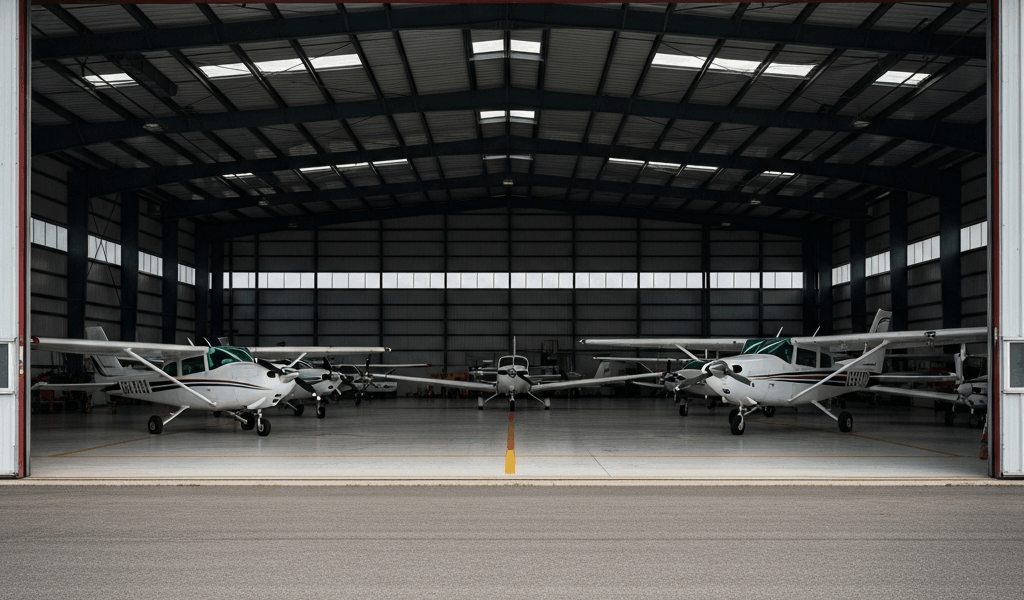
Why Hangar Rental Costs Vary So Much Across States
Hangar rental has gotten complicated with all the misinformation flying around — pilots quoting rates from three years ago, airport managers holding firm on prices that don’t match reality, and online forums full of outdated numbers. As someone who’s spent time researching general aviation infrastructure across dozens of states, I learned everything there is to know about what actually drives these costs. Today, I will share it all with you.
So, without further ado, let’s dive in.
The short version: airport hangar rental costs by state in 2026 swing wildly — sometimes by 300% or more. Land values tell half the story. A square foot in coastal California runs $15–$20. The same land in rural Montana sits at $2–$3. But it’s much more than that.
State funding models matter enormously. Some states subsidize general aviation airports heavily. Others treat them like any municipal asset and charge straight market rates. Pilot density changes the whole equation. Crowded metros like Los Angeles, Miami, and Dallas have waiting lists stretching 18 months. Smaller regional airports in the Midwest sometimes have empty hangars collecting dust.
Climate plays a role that pilots don’t always factor in — at least not until their first $4,000 paint job gets wrecked by hail. Sun and heat demand aircraft protection. Snow and ice make it non-negotiable. States with brutal winters charge more because hangar demand stays constant year-round. Desert states see seasonal spikes when snowbirds roll in. Facility age matters too. A newly renovated T-hangar complex charges differently than a 40-year-old structure with a leaky roof and questionable wiring.
Hangar Rental Price Ranges by Region
West Coast
The most expensive region in America. Full stop. T-hangars — single-aircraft spaces — run $400–$900 monthly. Box hangars, the larger climate-controlled variety, hit $1,200–$3,500. California dominates the high end, which surprises nobody.
At Santa Monica Airport (SMO), expect $650–$850 for a T-hangar if you can even get off the waiting list — currently sitting at 24 months out. San Jose (SJC) hovers around $750 monthly for comparable space. Oakland (OAK) offers slightly better pricing at $550–$700, mostly because real estate pressure in the immediate area is a touch lower than the Bay proper.
Washington and Oregon bring some relief. Seattle-Tacoma (SEA) runs $480–$620. Portland (PDX) averages $420–$580. Still expensive by national standards, but practically reasonable if you’ve been staring at Bay Area quotes all afternoon.
Mountain West
T-hangars land in the $250–$500 range. Box hangars: $700–$1,400. Denver International (DEN) charges $480–$620 — high for the region, but demand justifies it. Colorado Springs (COS) sits at $350–$450. Aspen (ASE) actually runs lower than most people expect: $320–$420, though availability during ski season is brutal in ways that have nothing to do with price.
Utah and Wyoming offer genuine bargains. Salt Lake City (SLC) averages $380–$480. Cheyenne (CYS) lands at $220–$310. Jackson Hole (JAC), despite its resort-town reputation and Teton views, charges $290–$380. That’s what makes the Mountain West endearing to us budget-conscious pilots.
Midwest
The sweet spot. T-hangars: $180–$350. Box hangars: $450–$900. Chicago (ORD and MDW) runs $420–$580 — sheer traffic volume drives that up. Minneapolis (MSP) averages $340–$460. But head out to smaller regional airports and the math changes fast.
Kansas City (MCI) sits at $280–$380. St. Louis (STL) averages $260–$360. Des Moines (DSM) and Omaha (OMA) both fall in the $200–$320 range. Rural Nebraska and Iowa airports sometimes charge $120–$200 for T-hangars. You’re trading proximity for savings. Whether that trade makes sense depends entirely on your schedule.
South
T-hangars: $220–$480. Box hangars: $600–$1,600. This region splits dramatically — metros versus everywhere else. Miami (MIA, FLL) demands $520–$750 for T-hangars. The waiting list is real and it’s not moving fast. Atlanta (ATL) runs $420–$580. Dallas-Fort Worth (DFW, DAL) averages $380–$520.
Exit the major cities and pricing drops 40–50%. Nashville (BNA) hits $300–$420. Austin (AUS) averages $340–$460. Smaller Texas airports in San Antonio, Houston suburbs, and rural areas land in the $200–$350 window. Louisiana and Mississippi airports often undercut regional averages by $50–$100 monthly — quietly, without much fanfare.
Northeast
T-hangars: $300–$600. Box hangars: $900–$2,000. Boston (BOS), New York (LGA, JFK), and Philadelphia (PHL) all sit in the $500–$700 range. Constrained runway capacity plus expensive real estate equals expensive everything. Waiting lists exist but move faster than California’s — which is admittedly a low bar.
Secondary cities offer real relief. Hartford (BDL) averages $380–$480. Providence (PVD) runs $340–$420. Smaller New England airports drop to $240–$360. Pennsylvania outside Philadelphia and Pittsburgh runs $280–$400. Honestly better than most pilots expect when they hear “Northeast.”
States Where Hangar Rentals Are Cheapest Right Now
Frustrated by $600+ monthly bills eating into your flying budget? These states reward serious consideration — or outright relocation.
Wyoming: Averaging $200–$300 statewide. Cheyenne Municipal and Laramie Regional both have availability right now. Newer funding from state aviation programs means better-maintained facilities than the prices would suggest.
Montana: $180–$280 monthly for T-hangars. Missoula (MSO) and Billings (BIL) remain underutilized despite excellent mountain access. Severe winters drive demand — but apparently not enough to drive prices up significantly.
Kansas: $160–$280. Manhattan Regional, Wichita Dwight D. Eisenhower (ICT) at the regional level, and rural airfields often have empty hangars sitting available. State funding for general aviation keeps infrastructure solid without attaching premium pricing to it.
Arkansas: $140–$260. Little Rock Regional (LIT) averages $220–$300. Smaller fields charge $120–$200. Low population density equals low demand. Simple math.
South Dakota: $150–$270. Pierre Regional and Sioux Falls (FSD) both undercut national averages comfortably. Winter doesn’t kill affordability here the way it does in the Northeast — somehow.
Iowa: $130–$240. Cedar Rapids (CID) and Des Moines (DSM) average $200–$320. Rural counties? Sometimes $100–$150. Agricultural economy means airports are treated as community assets rather than revenue centers. That’s what makes Iowa endearing to us frugal pilots.
Oklahoma: $170–$290. Will Rogers World (OKC) runs $280–$360. Regional airports drop 30–40% below that. The state aviation fund keeps rates genuinely competitive.
States Where Demand Is Outpacing Supply
Frankly, if you live in these places, start planning yesterday.
California: The crisis state. Coastal T-hangars: $600–$900+. Box hangars: $1,500–$3,500. Frustrated by those numbers, owners are doing three things: renting portable hangars at $200–$400 monthly as stopgaps, splitting box hangars with other pilots to cut costs, or relocating to Fresno (FAT, $350–$450) or Bakersfield (BFL, $280–$380) and accepting 90-minute commutes to their aircraft. Waiting lists at Santa Monica, Van Nuys (VNY), and Long Beach (LGB) run 18–36 months. That’s not a typo.
Florida: Miami, Fort Lauderdale, and Tampa metros all report 12–18 month waits. T-hangars run $480–$750. The seasonal snowbird influx — roughly November through April — creates temporary shortages that feel anything but temporary when you’re living through them. Smart pilots lock in annual leases during summer when demand drops 20–30%.
Texas: Dallas-Fort Worth and Houston suburbs are supply-constrained. Austin’s growth has pushed available inventory down to roughly 2–3 months of supply. San Antonio remains chronically undersupplied. Satellite airports — Addison, Waco, Huntsville — offer 30–40% discounts for pilots willing to base outside the metro cores.
Arizona: Phoenix’s growth has tightened supply considerably. T-hangars run $350–$480. Scottsdale Airport (SCF) commands premiums above regional average. Tucson (TUS) remains the sensible alternative at $240–$320.
Price only matters after the space works for the airplane. Compare T-hangars, box hangars, community storage, portable structures, and measurement requirements in our small-aircraft hangar selection guide.
How to Use This Data When Negotiating a Hangar Lease
Probably should have opened with this section, honestly. Knowing the regional average is leverage — real, usable leverage that most pilots leave sitting on the table.
When an airport manager quotes $650 for a T-hangar and your state average is $480, you have something concrete. Say it directly: “I’ve researched five regional airports within 60 minutes of here. Your price is 35% above market. What flexibility exists?” Many managers will counter-offer or discuss a multi-year discount rather than watch a tenant walk. Don’t make my mistake of accepting the first number quoted. I paid $580 monthly at a Colorado Springs-area field for eight months before asking the question. Turned out $480 was available the whole time.
Multi-year leases unlock real savings. A 3-year commitment often yields 10–15% discounts. Five-year deals can hit 20%. Lock in pricing during a stable market and you’re insulated against the 2026–2027 rate increases most aviation finance people are anticipating.
Off-season pricing exists — but pilots almost never ask. December through February sees reduced demand across most regions. If an airport is sitting on empty hangars, $450 beats zero revenue every time. Ask about seasonal rates, especially if you’re flexible about temporary arrangements or hangar-sharing during slow months.
Upcoming construction changes the whole landscape. Contact your county airport authority and ask about 3–5 year development plans. New facilities launching in 2026–2027 will compete hard for tenants with introductory pricing. Being on a pre-launch notification list costs nothing and can save hundreds monthly.
Portable hangars — typically $200–$400 monthly — aren’t identical to permanent spaces. But they’re a genuine alternative to sitting on a two-year waitlist. I’m apparently a portable-hangar convert at this point, and the Rhino Shelter model I’ve been using works fine while the permanent spot I’m waiting on at (BFL) never seems to open up. Some pilots base aircraft under portable covers at secondary airports while holding their place in line at preferred locations. It’s not glamorous. It works.
Want to dig into specific airports? Our hangar search tool lets you compare rates, availability, and amenities across 500+ U.S. airports. Filter by state, price range, and facility type — then connect directly with airport managers. Finding the right hangar isn’t guesswork when you’ve got the data in front of you.



Stay in the loop
Get the latest aircraft hangar finder updates delivered to your inbox.