Portable Aircraft Hangars — Are They Worth It for Your Plane?
This article includes affiliate links. We may earn a commission at no extra cost to you.
Portable aircraft hangars have gotten complicated with all the manufacturer fluff and forum noise flying around. I went deep on this two years ago when the waiting list at my home field hit three years. Three years. My Cessna 172 was sitting on the ramp getting cooked by Texas sun and peppered by cormorant droppings — those birds had completely colonized the ramp trees — and I needed something real. Not a $180,000 T-hangar build. Not a 2027 move-in date. So I researched, bought, installed, and have now lived with a portable fabric hangar long enough to give you the honest version. Not the brochure version.
Short answer: yes, for a lot of pilots in a lot of situations, they’re absolutely worth it. But there are real limits, and nobody selling you one is going to volunteer those details unprompted.
Compare that option with T-hangars, box hangars, and community storage in our guide to hangars for small aircraft, including door measurement, tow-path, lease, and airport-rule checks.
What Portable Hangars Actually Are
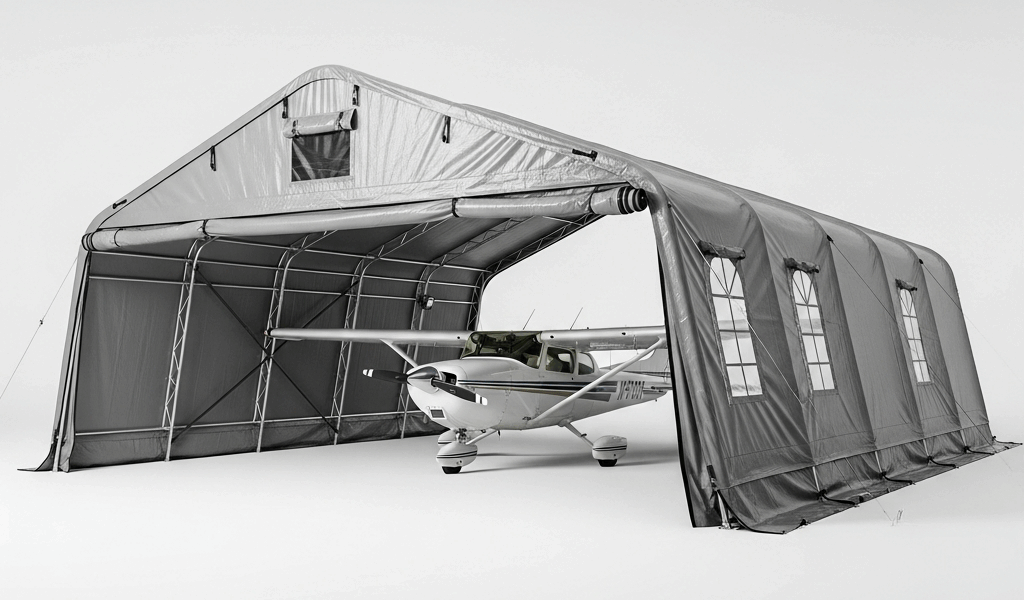
But what is a portable aircraft hangar? In essence, it’s a fabric-over-steel-frame structure — think a heavy-duty version of the carport kits at your local farm supply store, but engineered specifically for aircraft dimensions and wind loads. But it’s much more than that.
The frames are galvanized steel tube, either welded or bolt-together. The covers are polyethylene or PVC fabric with UV inhibitors woven into the material. Brands like ShelterLogic, Cover-It, ShelterPort, and the more aviation-specific offerings from American Pole Barn and RedGuard dominate the market. The higher-end options — the RedGuard RG40 series, the ShelterPort 42-foot wide units — use 17-oz to 21-oz fabric rather than the flimsy 9-oz stuff you’ll find on cheaper carport covers. That weight difference matters more than anything else on the spec sheet.
Most units anchor using auger-style ground screws, concrete footings, or heavy ballast blocks on a concrete ramp. Semi-permanent is the right mental model. You can move them, but it’s a half-day job with a few people, not a quick teardown. Larger units — anything covering a 40-foot wingspan — typically go up in a weekend with four to six people and stay put for years afterward.
They’re not inflatable. They’re not tents. The steel frame carries the load; the fabric is just the weather envelope. That distinction matters when you’re deciding how seriously to take them as real aircraft protection.
Protection Level — What They Stop and What They Don’t
Probably should have led with this section, honestly, because this is where the decision actually lives.
Rain. Stopped completely by any decent fabric cover. If the cover is properly tensioned and the doors seal reasonably well, your plane stays dry. Two years in central Texas — including some genuinely nasty spring storms — and I’ve had zero water intrusion.
Sun and UV. One of the biggest wins, full stop. Avionics, plastic, rubber seals, paint — all of it degrades faster under direct sun than almost anything else in normal storage. A good fabric cover blocks 90%+ of UV. My interior plastics look noticeably better than my hangar-mate’s plane, which spent six months on the ramp while he waited on a maintenance slot.
Bird droppings. Eliminated. This alone justified the purchase for me. I was wiping the airplane down every single preflight before I got the hangar up.
Hail. Here’s where it gets honest. Light hail — quarter-sized and under — the fabric absorbs and the structure deflects reasonably well. Golf ball or larger hail at an angle in high winds? The fabric won’t dent your plane, but a structural failure in a severe storm could cause real problems. I anchor into concrete with 5/8-inch rebar anchors and haven’t had issues — but I’ve heard from pilots who lost portable hangars in severe thunderstorm outflow winds. The structure is only as good as its anchoring, full stop.
High winds. This is the real variable. Most fabric hangar manufacturers rate their structures for 65–90 mph winds when properly anchored. Key phrase: when properly anchored. Don’t make my mistake — my first installation used the manufacturer’s provided auger screws in sandy soil, and one corner lifted in a 55 mph gust. I pulled everything, re-anchored with 36-inch rebar driven at 45-degree angles into deeper soil, and haven’t had a problem since. Match your anchoring system to your actual soil conditions, not just the instructions in the box.
Temperature. They do reduce heat buildup compared to an airplane sitting in direct sun — not as well as an insulated metal hangar, but meaningfully better than the ramp. On a 100°F Texas afternoon, my IR thermometer reads about 78–82°F inside with the vents open. That’s a 20–25°F difference. Better for everything from avionics to your seat upholstery.
Cost vs Permanent Hangar — When the Savings Justify the Tradeoffs
As someone who stared down a $180,000 construction quote before going the portable route, I learned everything there is to know about what this decision actually costs.
A quality portable hangar sized for a single-engine GA aircraft — a 40-foot wide by 40-foot deep unit fits a Cessna 182 or Piper Cherokee with room to move around — runs $5,000 to $15,000 installed. High-end units with better fabric, stronger frames, and roll-up doors with proper sealing push toward $20,000–$30,000. That sounds like a lot until you look at the alternative.
New T-hangar construction at a small airport typically runs $150,000 to $250,000 depending on location and slab costs. Rental rates in desirable areas run $400–$900 per month for a single-engine aircraft. At $500 a month, you’re spending $6,000 a year on rent. A $12,000 portable hangar pays for itself in two years — and you own it. The math gets even more compelling if you own rural property with a private airstrip or you’re based at a small grass field with no existing hangar infrastructure at all. In those situations, a portable hangar isn’t just cheaper. It’s the only practical option short of a major construction project.
Where the tradeoff breaks down: if you’re at a busy controlled field with a reasonable wait list and fair hangar rates, the protection and convenience of a proper metal structure is worth the premium. Portable hangars have real limits in severe weather regions — Tornado Alley, hurricane country — and you need to think hard about whether $15,000 of fabric structure is adequately protecting a $150,000 aircraft.
Lifespan and Maintenance — What the Warranties Don’t Tell You
The frames last. Galvanized steel tube, properly maintained, will go 20–30 years without structural issues. That’s not the wear item.
The fabric covers typically last 10 to 15 years under normal conditions. UV exposure degrades the material over time — you’ll notice color fading first, then reduced UV blocking, eventually cracking or tearing around grommets and tensioning points. A replacement cover for a 40×40 unit runs $1,500–$3,500 depending on fabric grade. Budget for it eventually.
Annual maintenance is real but manageable. Every spring I spend about three hours on the following: checking all anchors for movement, inspecting every grommet and tensioning strap, applying 303 Aerospace Protectant to the fabric with a garden sprayer — about $30 for a gallon — checking frame connections for looseness, and lubricating the door hardware. Total material cost runs under $100.
The seams deserve attention, apparently more than most people give them. On lower-cost units, seam tape can delaminate after a few years. I patch mine with Tenara thread and HH-66 vinyl cement when I catch early separation — a 10-minute fix when you’re on top of it, a much bigger headache if you let it go through another season.
When a Portable Hangar Makes Sense — Real Scenarios
Frustrated by a three-year hangar wait list, I bought my portable unit using a debit card and a weekend’s worth of research — probably not the most methodical approach. Here are the situations where portable hangars are genuinely the right answer:
- Rural private strips — If you have a grass strip on your property, building a permanent hangar is a major undertaking. A quality portable structure gets your plane protected for a fraction of the cost and can be up in a weekend with a few friends and a case of beer.
- Waiting out a hangar list — Airport hangar lists at decent fields can run two to five years. A portable hangar on a tie-down spot bridges the gap without leaving your aircraft on the ramp — check with your airport manager first, though, because policies vary significantly.
- Temporary storage during a build or extended annual — If your usual hangar becomes unavailable or you’re doing extended work on a second aircraft, portable units work well as temporary covered workspace.
- Seasonal storage in northern climates — Many northern pilots hangar their aircraft October through April. A portable unit handles winter storage without a permanent structure commitment.
- Backup protection at a fly-in or extended trip — Some pilots bring portable canopy covers — smaller than full hangars, same concept — for multi-day fly-ins where covered storage isn’t available on the field.
That’s what makes portable hangars endearing to us GA pilots — they solve real, specific problems that permanent infrastructure simply can’t address quickly or affordably.
They’re not the right answer if you’re in a high-wind or severe weather region without exceptional anchoring infrastructure, if your airport prohibits temporary structures on tie-down rows, or if you’re storing a high-value aircraft where marginal weather risk outweighs the cost savings.
My honest bottom line after two years: this hangar has done exactly what I needed. My plane is clean, the paint looks good, and I’ve spent maybe $200 total in maintenance costs. It’s not a solid metal T-hangar — I won’t pretend otherwise. But for pilots navigating long wait lists, limited budgets, or remote locations, a properly anchored, quality fabric hangar is serious infrastructure. Not a compromise you’ll regret.



Stay in the loop
Get the latest aircraft hangar finder updates delivered to your inbox.