T-Hangar vs Box Hangar — Which Is Right for Your Small Plane?
This article includes affiliate links. We may earn a commission at no extra cost to you.
Hangar shopping has gotten complicated with all the conflicting advice flying around — forums swearing by box hangars, budget-conscious pilots defending t-hangars like it’s a personal philosophy. As someone who’s rented both for years across multiple airports, I learned everything there is to know about what actually breaks down in daily use versus what sounds good on paper. I’ve frozen my fingers preheating a Lycoming O-320 at 6 AM in January inside a t-hangar. I’ve also paid a monthly rate that made my accountant physically wince for a box hangar I visited maybe twice a week. Neither option is perfect. But one of them almost certainly fits how you actually fly — and that distinction matters more than any side-by-side spec comparison.
This isn’t an engineering breakdown. It’s a decision guide written from the owner’s seat, covering cost, convenience, security, and whether you can actually get real work done inside. Those are the four things that will affect your life as a pilot every single week.
T-Hangar — The Affordable Choice
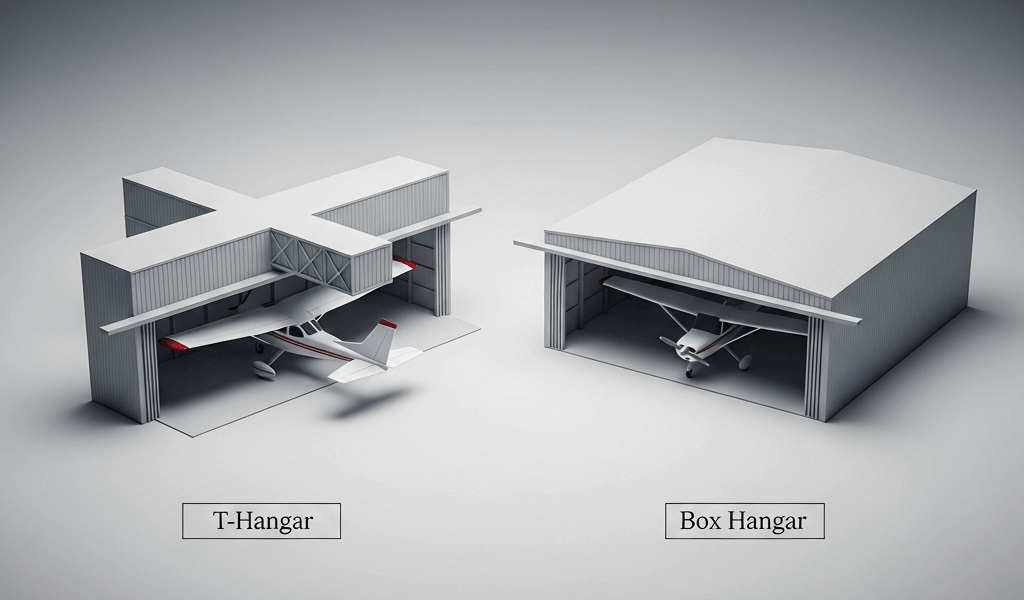
T-hangars are the bread and butter of small GA airports. Walk the ramp at any busy Class D or uncontrolled field and you’ll see rows of them — those distinctive angled, interlocking units that look from above like stacked T-shapes. Each unit shares a wall with its neighbor. The design is intentional. By nesting aircraft nose-to-tail in alternating directions, airports pack more planes into less linear footage. That density keeps the rent low.
But what is a t-hangar, really? In essence, it’s a compact shared structure built around a single aircraft. But it’s much more than that — it’s a whole operating environment with real constraints you’ll live inside every time you fly.
A typical unit fits one small aircraft — a Cessna 172, Piper Cherokee, Beechcraft Bonanza — with maybe four feet of clearance on either wingtip if you’re lucky. Wingspan is the real constraint. My first t-hangar at KPWK had a 42-foot opening and roughly 38 feet of interior depth. My 172 fit with room to walk around it. A friend in the adjacent unit trying to keep his Cirrus SR22 was doing some genuinely creative taxi angles every single time he moved the airplane.
The shared-wall design raises one legitimate concern — hangar rash. If your neighbor is clumsy with their tug at 7 AM, your wingtip is closer to theirs than you’d like. Most rows have a dividing wall or recessed channel separating units, which helps. But you’re not in a private bubble. You’re in a shared structure, and you’ll want to know who your neighbors are before you sign anything.
For pilots who fly regularly but don’t do their own maintenance, the t-hangar is excellent. It keeps the sun off the avionics, the rain off the paint, and the birds off the windshield. That’s its job — and it does it well.
Who Actually Thrives in a T-Hangar
- Weekend flyers logging 50–100 hours per year
- Owners with factory-built aircraft that go to a shop for maintenance
- Pilots at airports where box hangars simply aren’t available
- Anyone prioritizing monthly cash flow over workspace
Box Hangar — Space to Work
A box hangar is exactly what it sounds like. Four walls, a wide door — usually hydraulic or bi-fold — and an open interior that’s yours alone. No shared walls. No neighbor’s wingtip drifting into your airspace. The door width is the first thing you notice. A standard box hangar door runs 40 to 60 feet across, and interior dimensions typically start around 40×40 feet and scale up from there. Some of the larger private units at reliever airports run 60×60 or bigger — 18-foot eave heights that can accommodate an aircraft on jacks with the gear fully extended.
That space changes everything about how you use the hangar. There’s room for a proper workbench along the back wall, a parts cabinet, a floor jack, maybe a compressor. You can pull the cowling and actually stand upright while you work on the engine. Burned by a magneto swap I tried doing in a cramped t-hangar with zero elbow room, I learned early that some maintenance tasks get genuinely dangerous when you’re contorted in a tight space with poor lighting.
Box hangars also give you real flexibility for guests. If a friend flies in from out of town and needs to tie down overnight, you can pull your aircraft slightly forward and fit a small plane alongside yours. You cannot do that in a t-hangar. Ever.
The wide door is a practical benefit people overlook, too. Taxiing in and out is a single straight roll — no angular repositioning. In winter, when the ramp is icy, this is not a small thing.
Who Actually Thrives in a Box Hangar
- Owner-assisted maintenance pilots doing their own annuals under A&P supervision
- Homebuilders with a project ongoing
- Pilots with larger or wider-wingspan aircraft
- Operators hosting a second aircraft or sharing space with a flying partner
- Anyone running a small flying club or partnership
Cost Comparison
Probably should have opened with this section, honestly — because for most owners this is where the conversation starts and sometimes ends entirely.
T-hangar rent varies significantly by region. Realistic range at most mid-size GA airports runs $300 to $600 per month. I’ve seen $275/month at a rural Illinois strip and $650/month at a suburban Chicago field — same basic product, very different real estate context. At publicly-owned airports, rates are often regulated or at least subject to some oversight. At privately-owned fields, it’s whatever the market will bear.
Box hangar rent typically starts around $500/month and runs to $1,500/month or higher for a full private unit in a high-demand area. A 40×40 box hangar near a major metro might run $900–$1,200/month. The same square footage in rural Kansas might be $450. Location dominates the math.
If you’re looking at building rather than renting, the cost differential widens considerably. A prefab t-hangar unit — think Schweiss or General Aviation — can be erected for $35,000–$55,000 depending on size and door type. A freestanding box hangar with a bi-fold door, concrete floor, and basic electrical runs $80,000–$150,000 or more for a well-equipped 40×50 structure. Steel prices have been unpredictable since 2021, so get current quotes. Numbers from two years ago aren’t reliable benchmarks anymore.
The cost question to actually ask yourself — and this is the one most people skip — is what’s the cost per flying hour of the hangar you’re renting? Fly 150 hours a year and pay $400/month for a t-hangar, that’s $32/hour just for shelter. Fly 40 hours a year in a $900/month box hangar, that’s $270/hour. Framed that way, the decision gets less abstract very quickly.
The Practical Differences That Matter
Here’s where I want to slow down — the real-world texture of daily hangar use doesn’t show up in any spec comparison, and it’s the stuff that will actually affect your mood every time you go to the airport.
Tug Access and Aircraft Movement
Getting a plane in and out of a t-hangar almost always requires a tug. The angled approach, the tight clearances, the specific positioning required just to clear the door — you can’t hand-push a 172 in there alone, not reliably. Most t-hangar rows have shared tugs or expect you to own one. A decent electric tug like the Tug MA-3 runs about $3,200 new. Factor that into your first-year cost if you don’t already own one.
A box hangar? Walk the plane straight in. Many owners hand-push a light single into a box hangar without any equipment at all. That’s not a trivial convenience at 6 AM when you just want to get airborne.
Winter Engine Preheating
Forced by a −12°F morning in Wisconsin to start a cold-soaked Lycoming without adequate preheat, I damaged a cylinder. Not catastrophically — but enough to show up on the next compression check and kick off a $2,100 repair conversation with my A&P. In a t-hangar, preheating options are limited. A Reiff or Tanis preheater system wired to a single outlet, maybe a small propane forced-air heater if the airport allows it. You’re working in an uninsulated metal box in the cold, often without room to set up properly.
In a box hangar with real electrical service, you can run an engine preheater, a small radiant heater, and still have outlets left for a battery maintainer and a shop light. The infrastructure makes winter flying genuinely more manageable — not just marginally better.
Workbench and Storage
T-hangars might be the best option for basic shelter, as that role requires nothing more than a secure door and a dry floor. That is because they were never designed to be workshops — they’re storage units with airplane-sized doors. There’s usually room for a small folding table and maybe a tool chest, but you’re working around your aircraft, not alongside it.
A box hangar lets you build out a real shop. I’ve seen setups with Snap-on roll cabs, a dedicated oil analysis station, parts washer, and a corner refrigerator for the long build days — one guy at KGYY had what amounted to a full machine shop in there, including a drill press bolted to a concrete pad. That’s an extreme case. The point stands, though. The space enables a category of pilot engagement that a t-hangar simply doesn’t support.
Security
Both hangar types offer roughly comparable protection against casual theft or weather. A t-hangar with a padlocked door is fine. A box hangar with a keypad entry and interior lighting is better. Neither is a fortress. The aircraft-specific measures — throttle locks, prop clubs, pull-out avionics drawers — matter more than hangar type. Don’t make my mistake of treating hangar selection as a security decision. The difference is marginal in practice, and you’ll miss the factors that actually matter.
The Verdict by Pilot Type
Here’s the clean version — you deserve a straight answer after reading this far.
You want a t-hangar if you fly without doing much hands-on maintenance, you care about keeping monthly costs predictable and modest, your aircraft fits within standard wingspan and depth limits (under 38 feet in most cases), and you don’t need the hangar to double as a workspace. This is the right call for the majority of recreational GA pilots flying a factory-built single. The money saved versus a box hangar is real — and if you’re not doing maintenance or projects in there, the missing workspace genuinely doesn’t matter.
You want a box hangar if you’re building or restoring an aircraft, you do your own maintenance or work closely with an A&P on condition inspections, you own a larger aircraft, you share costs with a partner who also needs space, or you simply value having a private, well-equipped place to spend time with your airplane. The higher monthly cost is justified by genuine utility. You’re paying for capability, not just shelter.
That’s what makes the hangar decision endearing to us GA types — it’s really just a proxy question for what kind of pilot you are. The pilots I’ve seen most frustrated with their choice are the ones who rented a box hangar for prestige reasons when a t-hangar would have served them perfectly, and the homebuilders who squeezed a project into a t-hangar and spent two years hating every single work session. Match the hangar to how you actually use it. Not how you imagine you will.
One last thing — before you sign any hangar lease, walk the row or the unit on a cold morning and a rainy afternoon. Talk to the pilots already renting there. Ask about wait lists, because at many airports the hangar you want has a two-year queue and sometimes longer. The best hangar type in the world doesn’t help you if it’s not available when you actually need it.




Stay in the loop
Get the latest aircraft hangar finder updates delivered to your inbox.