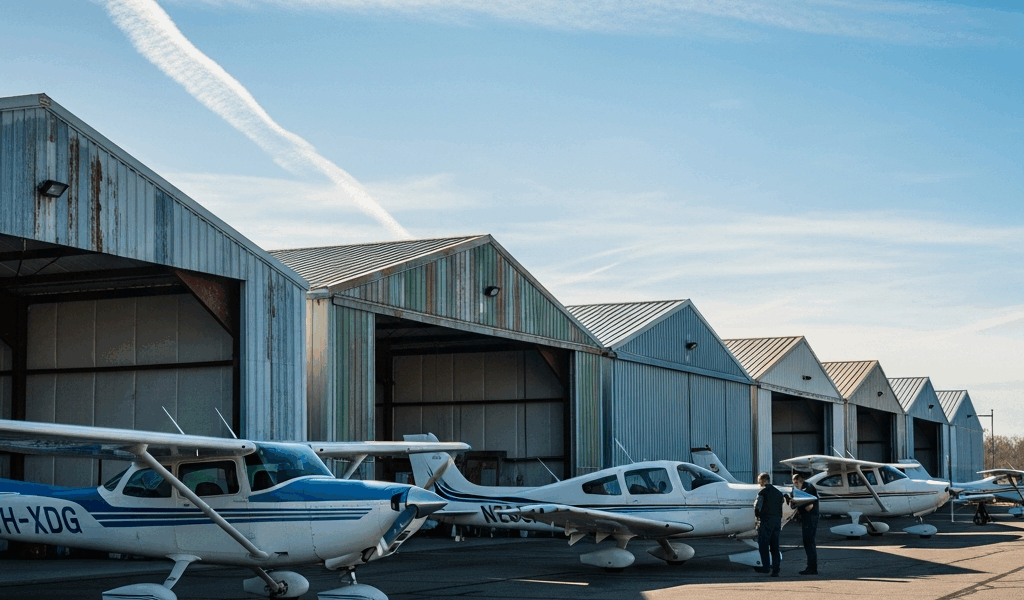
You have an airplane and need a place to keep it. The sticker shock on hangar costs hits different when you realize that storing your aircraft might cost more per month than flying it. T-hangars, box hangars, and portable hangars cover a wide price range — and picking the wrong type for your aircraft and airport wastes money every month.
T-Hangar: The Standard Single-Aircraft Solution
T-hangars are the most common single-aircraft hangars at general aviation airports across the country. The name comes from the interlocking T-shape — each unit nests into the next, sharing walls to reduce construction cost. A typical T-hangar fits aircraft with wingspans up to about 40 feet (Cessna 172, Piper Cherokee, Mooney, Beechcraft Bonanza).
Monthly rent ranges from $200 to $800 at most airports, with major metro areas pushing to $1,200 or higher. San Francisco Bay Area T-hangars regularly hit $1,000+. Rural airports in the Midwest run $200 to $400. The national average sits around $400 to $500 per month. Waitlists at popular airports can be years long — some airports in California and the Northeast have 5 to 7 year waits for a T-hangar.
T-hangars provide basic weather protection but limited workspace. Most are tight enough that opening doors with the aircraft inside requires careful choreography. No room for a workbench or parts storage in most configurations. Power may or may not be included — check before you sign the lease.
Box Hangar (Community Hangar): More Space, Shared Access
Box hangars — also called community hangars or corporate hangars — are large open structures that house multiple aircraft in a single space. Think of a warehouse with a big door. Aircraft are parked wing-to-wing and must be moved by hand or tug to get to aircraft parked behind others.
Monthly cost is typically lower per aircraft than a T-hangar — $150 to $500 per month at most airports. The trade-off: your aircraft sits next to other aircraft with minimal separation, and accessing your plane may require moving someone else’s first. Ramp rash (hangar rash) — dents and scratches from other aircraft being moved nearby — is a real risk in crowded community hangars.
Box hangars work well for aircraft owners who fly frequently (so the aircraft is rarely blocked in) and who prioritize cost savings over convenience. They work poorly for owners who fly infrequently and do not want to coordinate with other hangar tenants every time they want to preflight.
Portable Hangars: The Budget Alternative
Fabric-over-frame portable hangars (brands like Shelter Logic, ClearSpan, and aircraft-specific companies like Hangarplex) offer weather protection at a fraction of permanent hangar cost. A new portable hangar sized for a single-engine aircraft runs $3,000 to $8,000 purchased outright. Installation on an airport tie-down spot — if the airport allows it — eliminates monthly hangar rent entirely after the initial purchase.
The catch: many airports do not permit portable hangars on their property due to aesthetics, building codes, or lease restrictions. Check with airport management before buying one. Wind resistance is also a factor — fabric hangars need proper anchoring, and a strong storm can damage or destroy a poorly secured unit. They provide UV and rain protection but minimal security and no insulation.
Portable hangars make the most sense at rural airports with relaxed rules, on private airstrips, or as temporary solutions while waiting for a permanent hangar spot to open up.
Building Your Own: The Long-Term Math
At airports that offer ground leases, building your own hangar is a long-term investment. A basic steel-frame hangar sized for a single-engine aircraft costs $30,000 to $60,000 to build, depending on size, door type (bi-fold vs sliding), concrete, electrical, and local labor costs. Ground lease from the airport typically runs $100 to $400 per month.
The math: if you are currently paying $600/month for a T-hangar ($7,200/year), a $50,000 hangar build on a $200/month ground lease pays for itself in under 10 years and gives you a hangar you can customize, expand, and potentially sell or sublease. Most airport ground leases run 20 to 30 years, making the investment worthwhile for long-term owners.
Which Option for Your Situation
Flying frequently from a major airport with T-hangar availability: rent the T-hangar. The convenience and protection justify the cost for an aircraft you fly regularly. Budget-conscious at an airport with community hangar space: the box hangar saves money if you can tolerate the shared access. Rural airport or private strip with relaxed rules: a portable hangar gives weather protection at minimal ongoing cost. Planning to own the aircraft for 10+ years at one airport: investigate building. The upfront cost is significant but the long-term economics are better than a decade of rent.




Stay in the loop
Get the latest aircraft hangar finder updates delivered to your inbox.